Can you describe your artistic style? What is your preferred medium, and why?
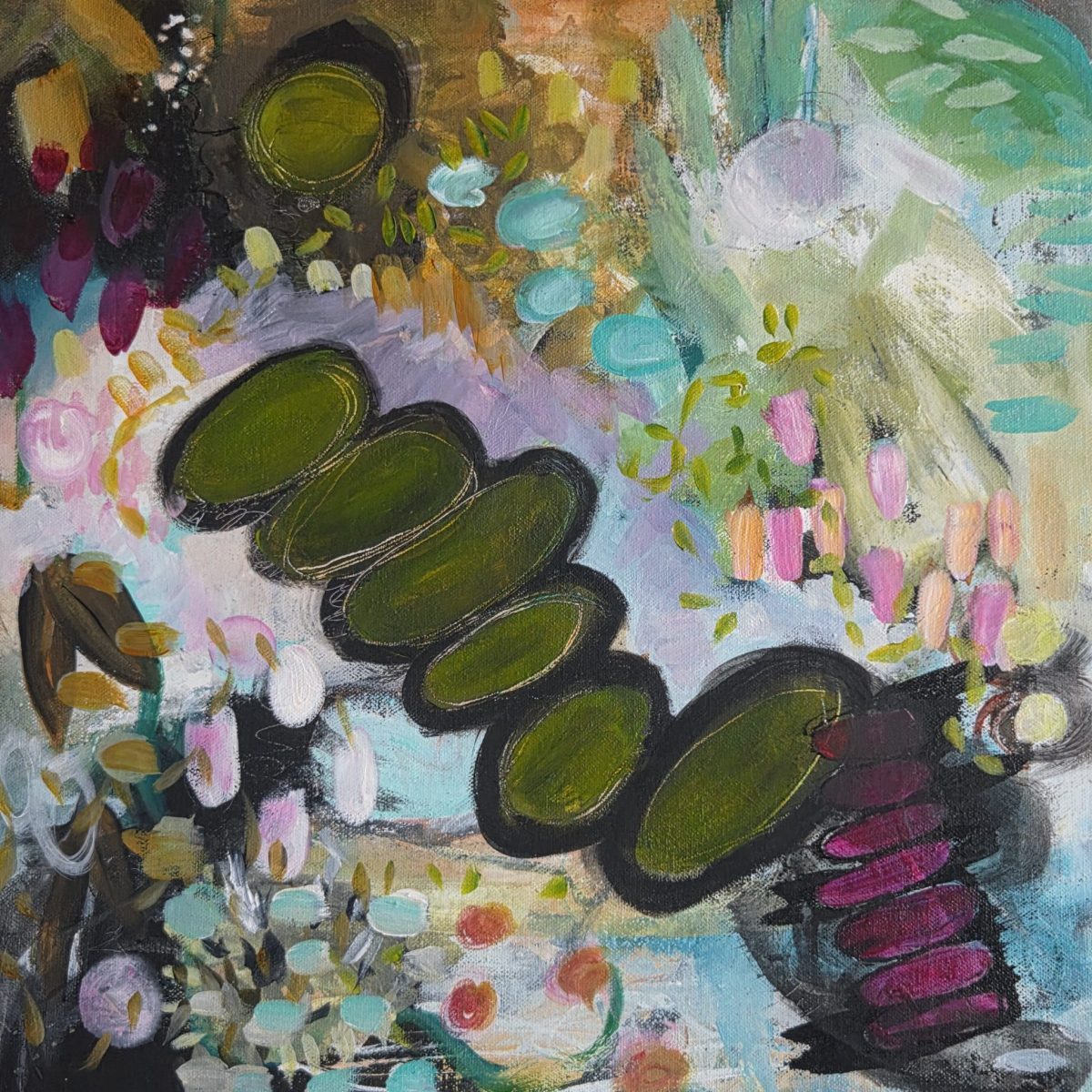
I never start a painting with an idea: I build up layers of signature marks, words, botanicals and colours I adore until something that feels right emerges. My work is expressive and semi-abstract: you’ll recognise flowers, leaves, stones, waterways… but I’m not trying to document anything literally, and nor do I want to. I need to share the feeling of the lushness of the rainforest and wet season, the mood of our water bodies, the way a garden looks when you turn your back on it during the wet. Painting with acrylic suits me because I’m impatient and intuitive, and I need a medium that keeps up with that.
What motivates you as an artist?
My brain seems to need it. I work in environmental consulting: bat data, spreadsheets, scientific reports, and painting is how I balance all that structure. Riotous, irreverent, playful flowers, colour, messy but poetic words. Sometimes fragments of handwritten text, or even part of a formula, find their way into the work, which feels like a perfect crossover between my two very distinct worlds. Living in Far North Queensland means I’m constantly visually inspired, by light, growth, weather and the natural world. I simply LOVE painting: colour, brushstrokes, sounds, staying curious.
Describe the best piece of art you have created.
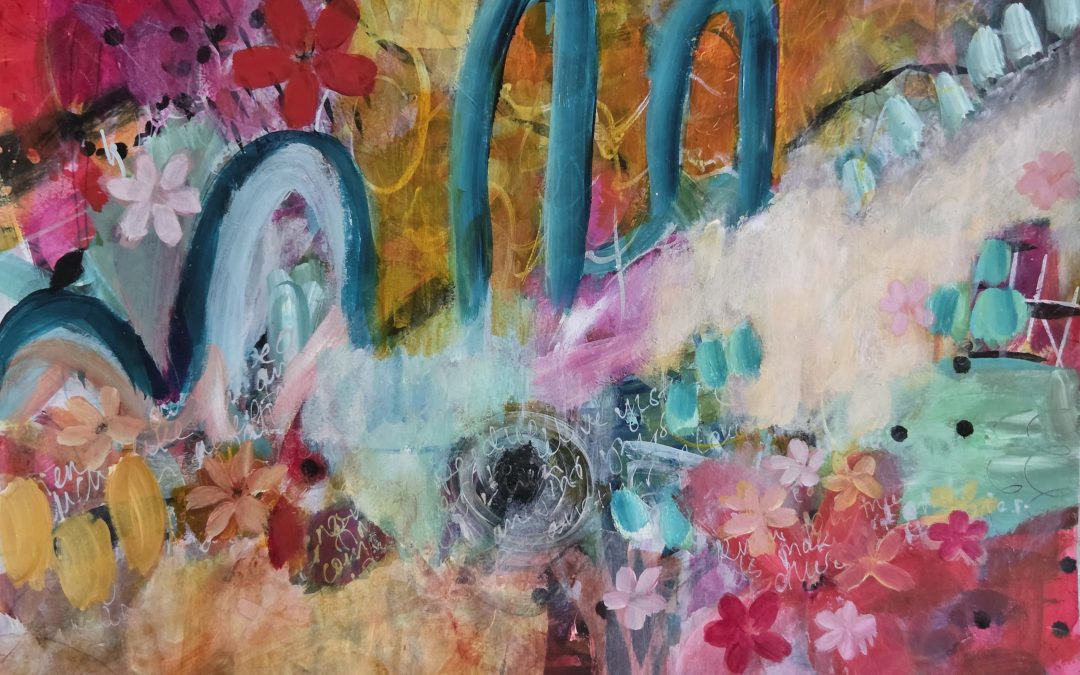
Honestly, ‘best’ is impossible, but a few stand out as significant. Riverbank Wilds (pictured) was an earlier work and I loved it for its accidental reflection of my daughter’s WA wildflower adventuring. There is a wild, yet uncomplicated energy to it, and what felt like a milestone was having the confidence to release it without second-guessing whether it was finished, or going back in and overworking it. Knowing when to stop is genuinely one of the hardest skills in painting.
What artists inspire you, and where do you find inspiration?
I try not to look at other artists’ work. I’m a sponge and I don’t want to subconsciously drift into someone else’s visual language. Riverbank Wilds, as mentioned, happened almost by accident, sparked by photos my daughter shared from her travels. I find inspiration in morning beach walks, the things the tide deposits, overgrown gardens left to their own devices, tangled growth, seed pods, and the intricacies of leaves up close. I find beauty in the untamed and a little wild. Words too, which is why handwritten text keeps appearing in my paintings, little whispers from me to you.
How do you learn new skills and techniques?
I occasionally participate in online workshops when I can, but it’s often by accident that I discover a new thing I love: a particular brush stroke; a motion that I enjoy repeating, or the way a painting suddenly comes alive when I add a pink or red flower. At the moment, I’m less interested in chasing new techniques than in clarifying what is already mine, so that what comes out feels unmistakably me. But for anyone wanting to start: I can’t recommend YouTube enough!! Endless resources and all for free.
What has been the most challenging and rewarding part of being an artist?
The constant surprise is the biggest reward for me. Every painting starts on a blank white surface, and I know that can feel intimidating for some artists, for me it can be the most exciting part. Absolutely anything goes and I have learned over the years that my paintings evolve layer by layer. In that sense, it’s like a choose-your-own-adventure: do I feel like painting leaves, or lines, or sharing some words? Sometimes the most challenging part can be letting go of sections I adore, sometimes the way colours look against each other or particular marks, when I know the painting needs something else..
What do you like to do when you’re not creating art?
I live five minutes’ walk from the beach, so of course I love early morning or evening beach walks, patting every dog that smiles back at me and collecting interesting things along the way. I also work in environmental consulting, which means I spend a fair bit of time in my office and have developed a slightly ridiculous love of data, compliance and well-organised systems.
Can you describe your studio/workspace and your favourite time of day to create?
I have a small studio space in my office, but I’m most at home painting at the kitchen table under a daylight LED. There’s something about that small, cosy circle of light that works for me. My favourite times are early morning while the world is still quiet except for the birds, and then again in the evening and into the night.
What is your favourite tool that you can’t do without?
I can’t choose just one. I love a good filbert brush because it makes the most satisfying petal. I also love silicone brushes for creating random and unexpected marks. Then there’s a 0.5 crochet hook and a special fine-line applicator. The scratched lines and handwritten text that weave through so much of my work often come from those.
Do you think art is important in society?
Yes, absolutely. Art makes people slow down, really look, and become curious. It can evoke memories or unexpected emotions; inspire, comfort and transport us. I also think art that celebrates wild, untamed natural places build a feeling of connection to Country and to nature, which matters because we don’t protect what we don’t love.
The fact that it’s often treated as a luxury or an extra is a real loss. Art tends to flourish where people feel safe enough to express something true, and it withers when they don’t.